TED’S SOAP BOX This is a sounding board where I can let off steam. For instance:
2022 was the year when Dale Kloppenburg and I turned 100! Hard to believe!
Dale is my oldest friend and we have led parallel lives - born in Fresno, California, similar schooling with degrees in science, interest in science, U S Navy, flying, plants, tropical fish and traveling collectinng. I got Dale interested in Hoyas about 1965 and we have gone on - he from the scientific side and I from the horticultural. He has turned into the most knowledgeable person about hoyas and has possibly the greatest Hoya library in the world.
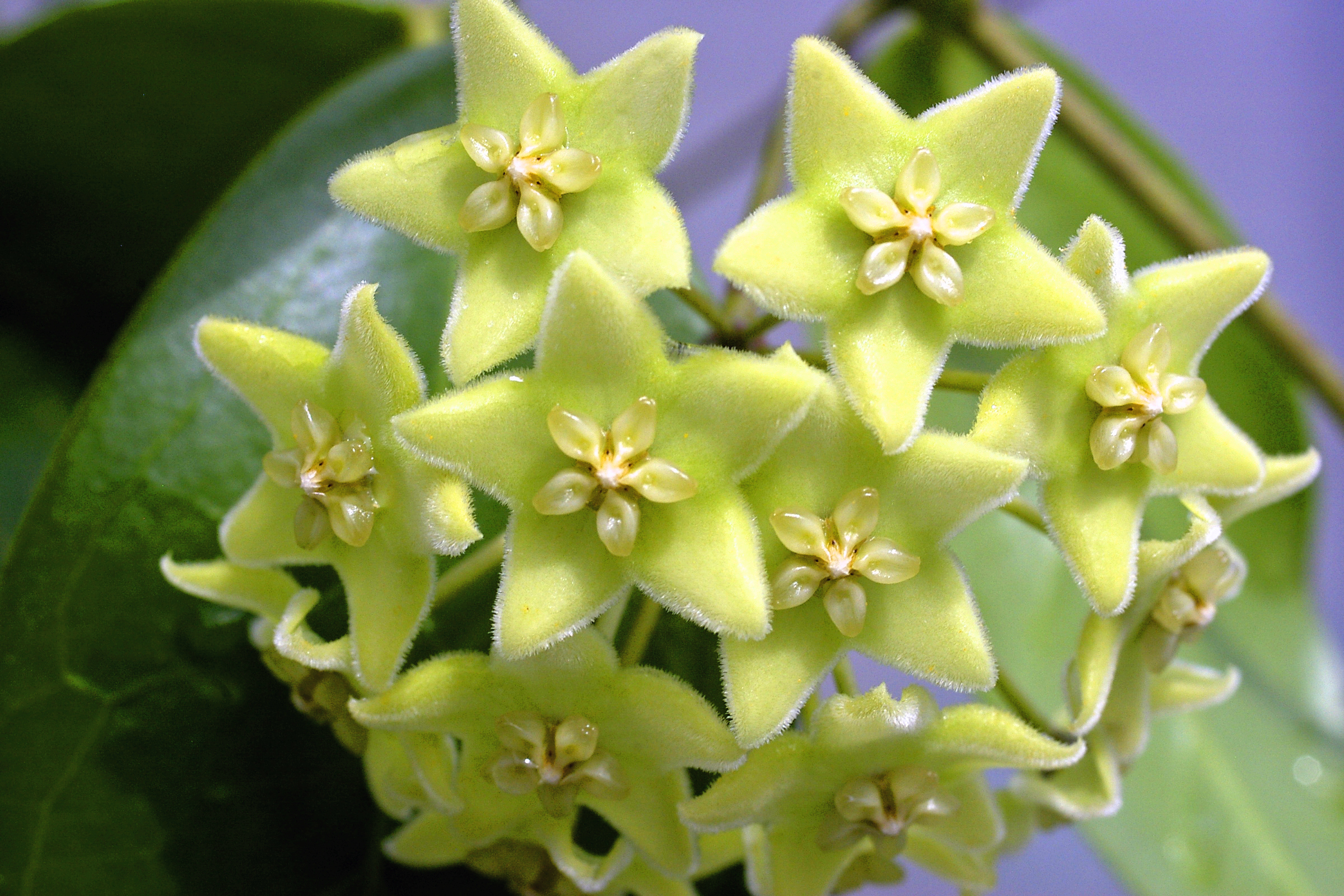
Value of Hoya schneei
About10 years ago, I made a very expensive (over $5,000) collective trip to Pohnpei, Micronesia to collect Hoya schneei - all to settle a question about the misnamed one in the trade, its similarity to H. chlorantha and to introduce it to the trade.
.jpg)
A year later, Dorothy and a were growing H. schneei, June 2011, in our garden here in Kaaawa, Hawaii. Too attractive? Someone stole it! and I have not been able to replace it! We estimate the value of this plant to be $1,500.
A. Most of the questions I am asked and also appearing on Facebook, Hoya 101, etc. have already been answered in my articles in Fraterna (the old Hoya magazine) as : David Silverman's DS-70 = Hoya tsangii, Burton. SO, I am going to use material from several. All of this right here in River City!
And, it might be of interest of those who haven't been lucky enough to travel and collect as I have in the past 40 years - so I will talk about some of my trips. This is a series and I will add things each time I update this website.
I highly recommend that beginners should read Ann Wayman and Dale Kloppenburg's book The World Of Hoyas - A Book Of Pictures, Not a bible but a good reference book. I believe that this is available online.
B. WHERE I FIRST COLLECTED CERTAIN SPECIES:
Hoya danumensis was a scrambling vine growing in a dry clump of small trees and bushes just outside of the Danum Valley preserve (close to Lahad Datu) in Sabah, Malaysia, The plant was not in flower but I guessed that it was either a Hoya or a close relative - with opposite, paired leaves, milky sap, etc. Seeing the flower later, I wished that it be H campulata but it was determined to be a new species. This area was reforested with a native Acacia and it was obvious that elephants liked it for the trees were stripped of its sweet bark. There were piles of dung from the elephants.
Hoya waymaniae, the first of this handsome species I found, was a plant growing in the forest litter at the top of the Kalang Waterfall - a few miles north of Tenom, Sabah. The whole area was very shady and the long flower stems stood above the litter - bearing orange flowers. The leaves were dark green. Close by, where the stems grew into the sun, the leaves developed a mottled red coloration.
Hoya clemensiorum, from a single leaf and stem that had fsallen from a high tree, near the Rafflesia Reverve. But the best I have seen was on the Long Miau river, by the landing strip at Long Miau - one leaf was 21" long!
C. COSTS OF COLLECTING: The 2 most expensive collecting trips I have made were for H. schneei ($5,000 to Pohnpei) (which I subsequently lost) and $3,500 for for H. desvoeuxensis, on the island of Taveuni, in Fiji. Dorothy says that a psychiatrist would have been cheaper!
D. HOYA BLOOMING?
How long do you have to wait for an established cutting to bloom? Some flower within 6 months of collection (a very rare rarity), most bloom within a year, and would you believe, that some have not bloomed in 8 to 10 years. My conditions are near perfect and I think that my plants have the best of conditions so I don't know the reasons for some not flowering early and regularly. Hoya imperialis alba and "Palawan" fall in that category. Contrarily, on my sunny front porch I have H affinis that I collected in 1976 on the Island of Tulagi (by Guadalcanal) and it started to bloom within a year and has bloomed regularly for the past 40 years.
Some clones of Hoya chlorantha, Hoya imperialis 'Palawan', and imperialis alba are temperamental and do not flower regularly.
I have found that H. mappigera, the form from Peninsular Malaysia, that first flowered in 6 months, now flowers continuously - hanging from the eave of our house - in 75% sunlight.
E.. There
are 2 types of taxonomist:
the lumper,
who considers the type, its varieties and subspecies –
as the species; whereas, the splitter will divide the type into
subspecies and varieties,as I state above. Personally, I am a lumper and accept the broad variations that occur within a species.
The
average hobbyist does not even see or notice the naked-eye characters (leaf
venation, the gland, etc.), let alone the tiny variations (pollinia, etc.) that
can be seen only with a microscope.
The hobbyist thinks the tiny differences are incidental.
The taxonomist thinks that they are extremely important in describing a
new species.
I contend that species must differ in at least
3 characters, with color not being one of them, to be valid. And, even then, I
believe that there must be at least 2,000 species of Hoyas. Every time we go
collecting we find plants that we might consider a new species. But, it is only my
opinion. Dale has a different opinion: I've always said we have only
collected in about 1% of the area and so 2000 is my guess as to the number of species.
I think we can walk right by a new species that is on the other side of a tree,
and
who gets off the trails, streams, roads or ridges?.
Very seldom, and vast areas in between are untouched by a collector”.
The average hobbyist is more aware of color,
fragrance, length of blooming time, and general overall appearance - all things
that are usually not considered by the taxonomist.
There
is no final authority to settle arguments between hobbyists, between hobbyist
and taxonomist or even between taxonomists. Many
times it is personal interpretation and personal opinion!
I have found that there is a group of new collectors who want the the latest and rarest species - with money being no object. I suggest they they study and find out how to start new cuttings and specifically about those new ones for it breaks my heart to hear back that they have lost some very rare things we sent them. In some cases it is experimenting with different ways of trying to root them.
F. I usually take people at their word and give them the benefit of the doubt. For instance, if they tell me that a shipment arrived in good condition and then 6 months later ask for a replacement of ones that have died, I get suspicious - especially, if I find out later that the cuttings were placed in a closed plastic bag. They claim that the shipment was of rotting plants. Would you believe the first statement or the last?
. Since 1998 when Dale Kloppenburg published it in Fraterna (based on my herbarium specimen), I have used the name "odetteae" for the handsome little thing from the Philippines that was named to honor Odette Cumming, wife of David Cumming (friends of mine from South Africa) whom I have collected with in the Phi;ippines. Now, someone pointed out that Chris Burton made a mistake in naming H. tsangii by citing the wrong herbarium sheet (H. angustifolia) and as a result gave it the name "odetteae" - how and why I will never know! This gets better, the one that I have always called H tsangii, with the dark fuzzy leaves and red flowers, is the one I am sure that Chris Burton meant to be tsangii. I don't think that David Silverman or Odette would be happy and Peter Tsang is turning over in his grave - I know that I am not happy. Should I tell Odette? If you understand all this explain it to me. Until the dust settles, I am going to continue to list my plants as I always have - angustifolia, tsangii and odetteae for they are all different.
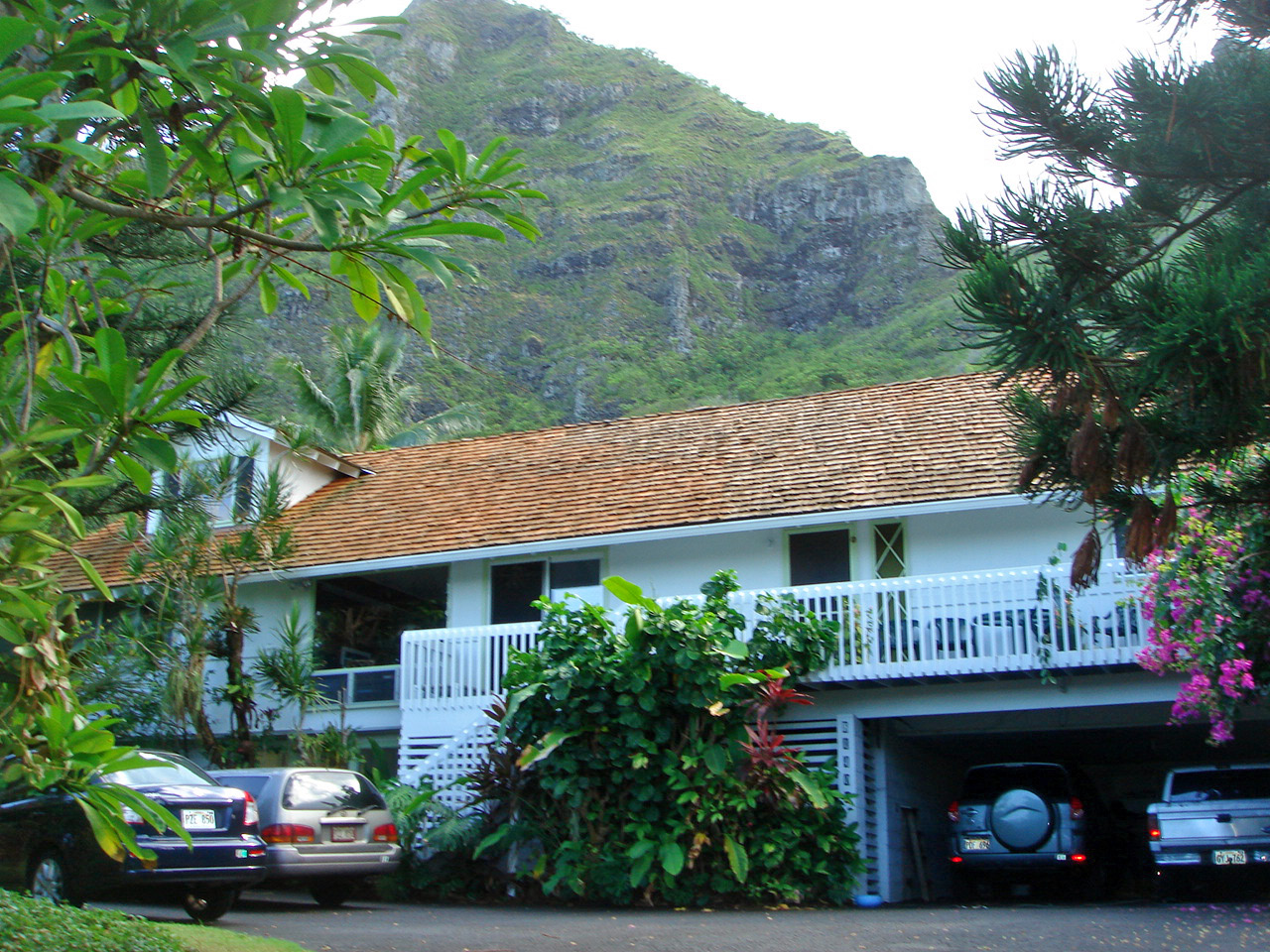
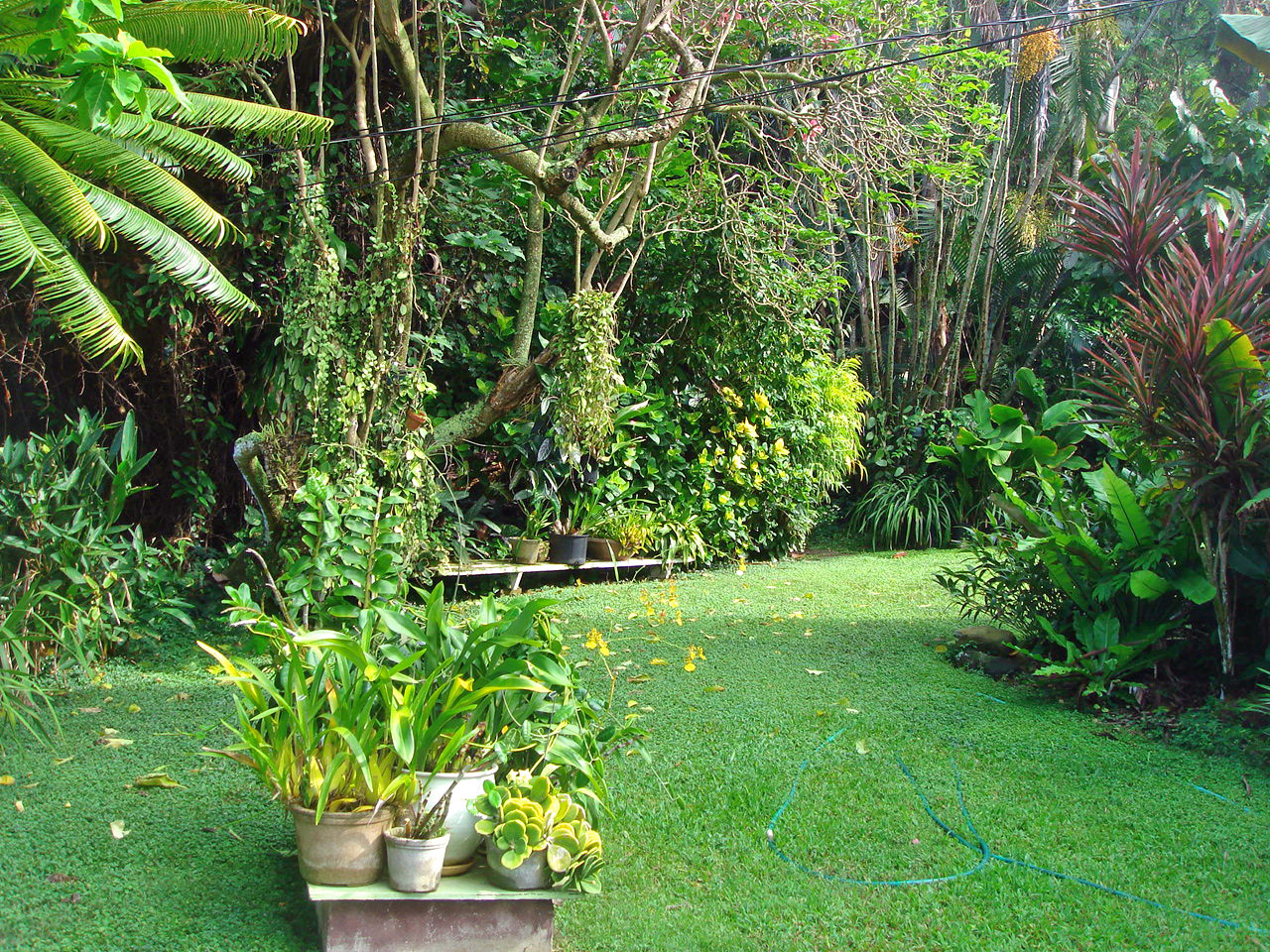
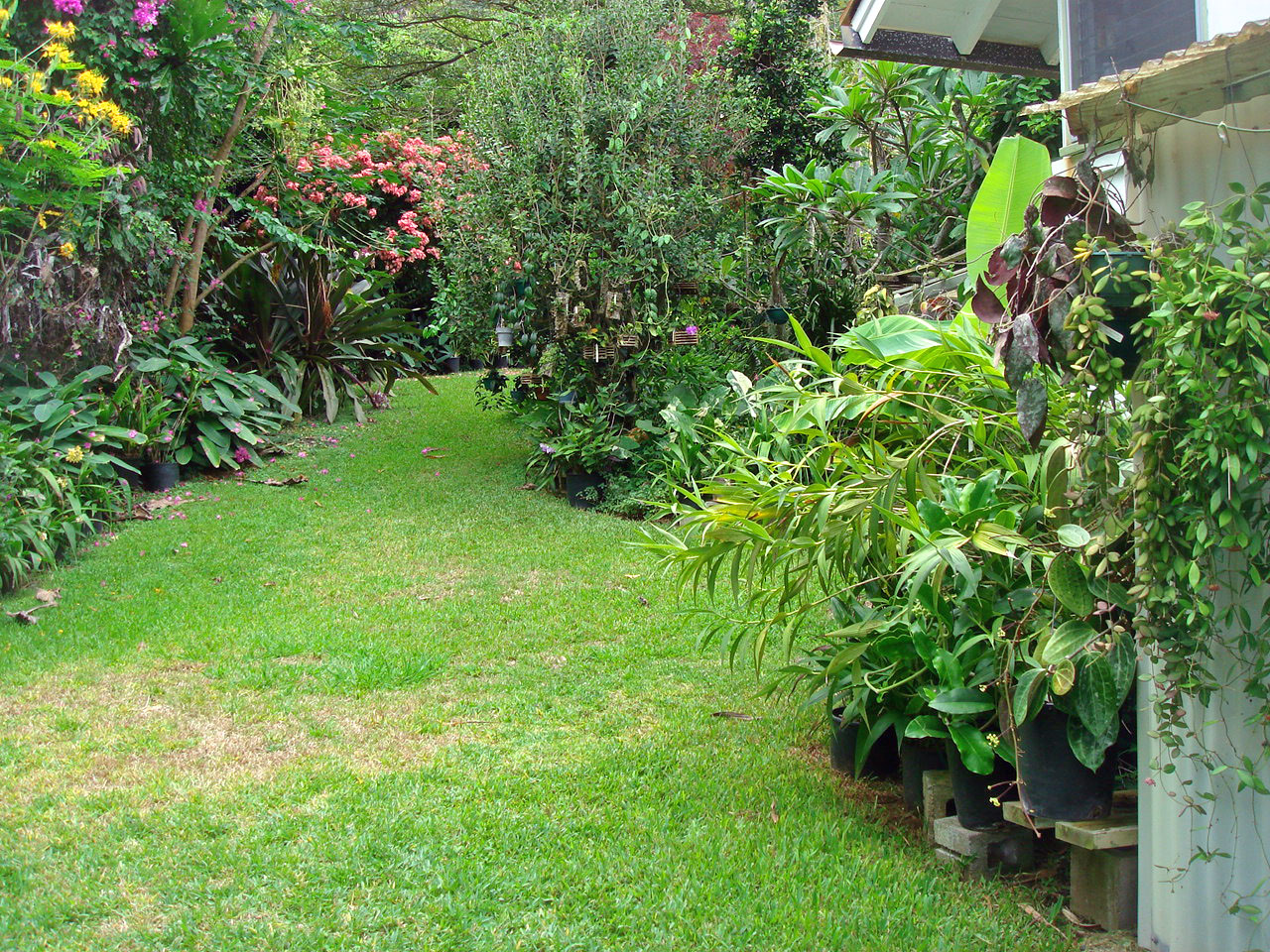
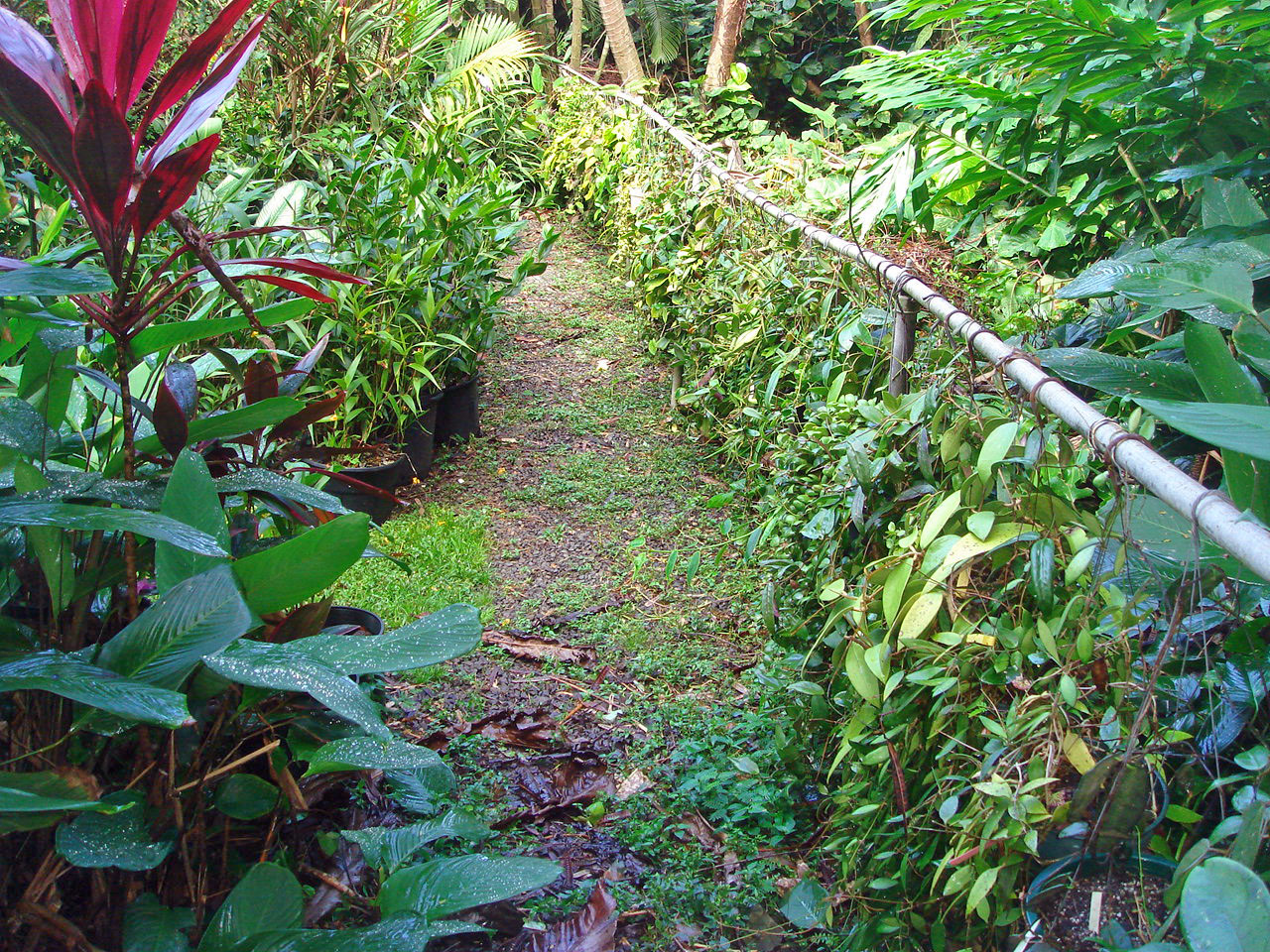
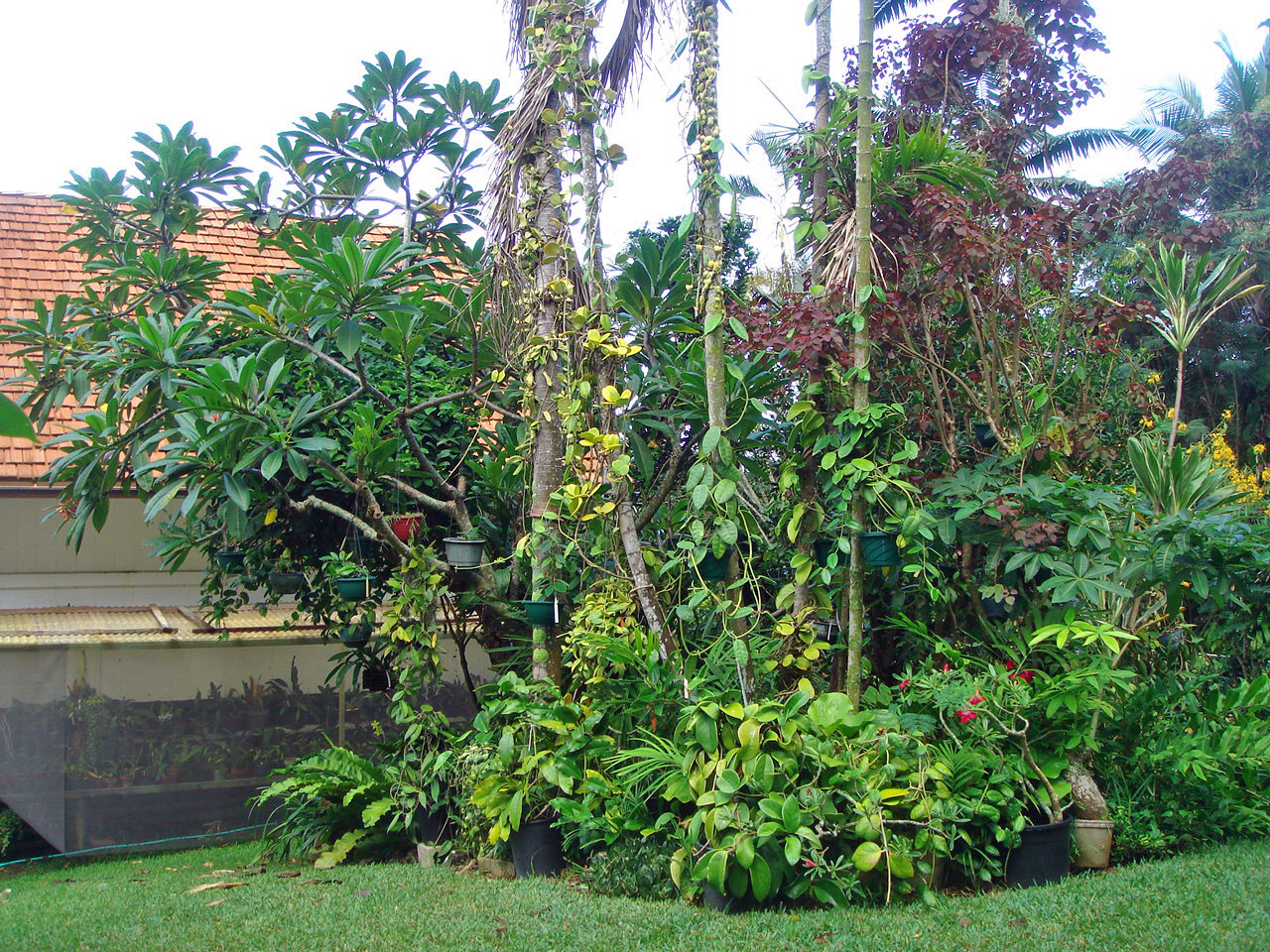
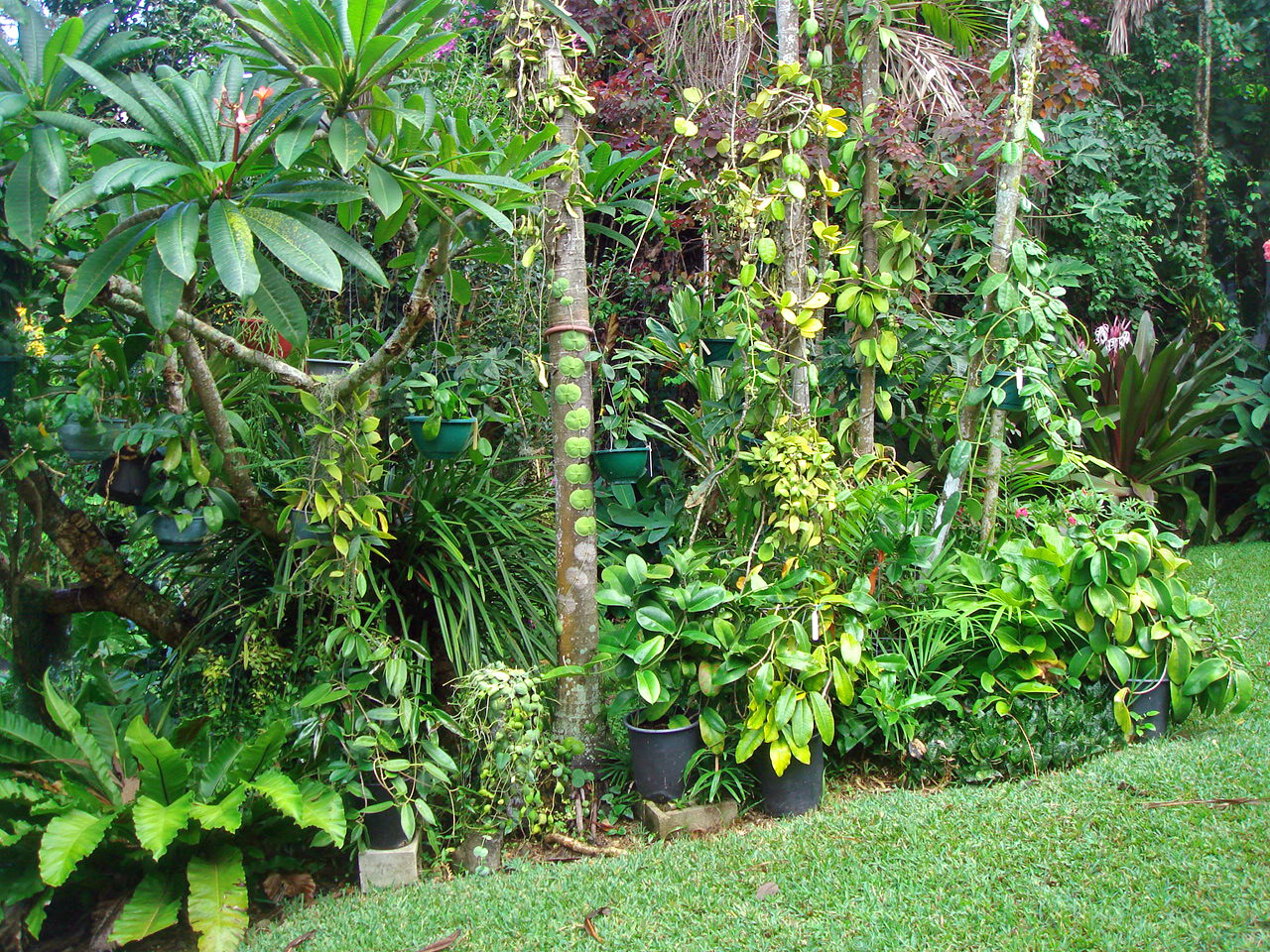
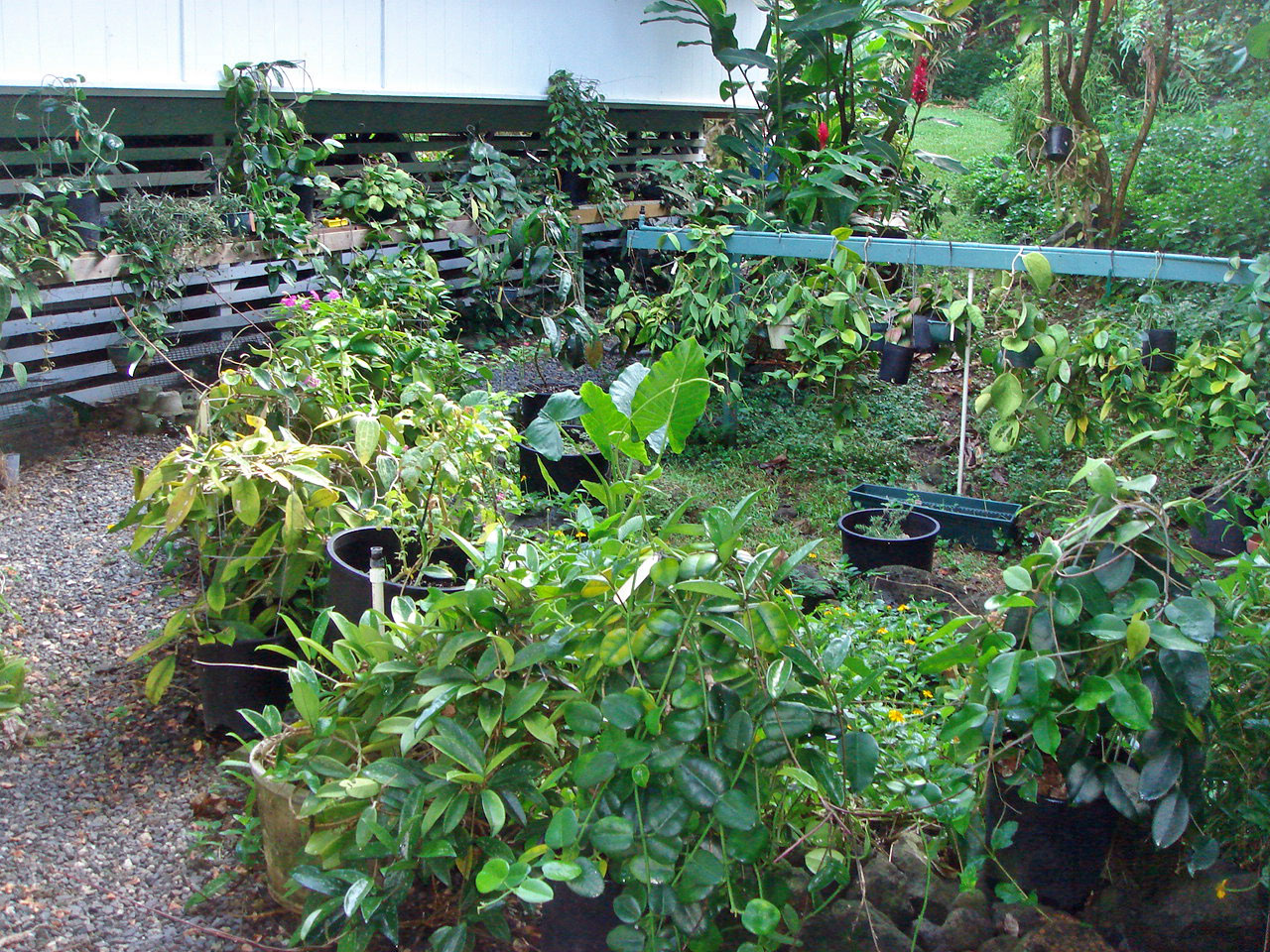
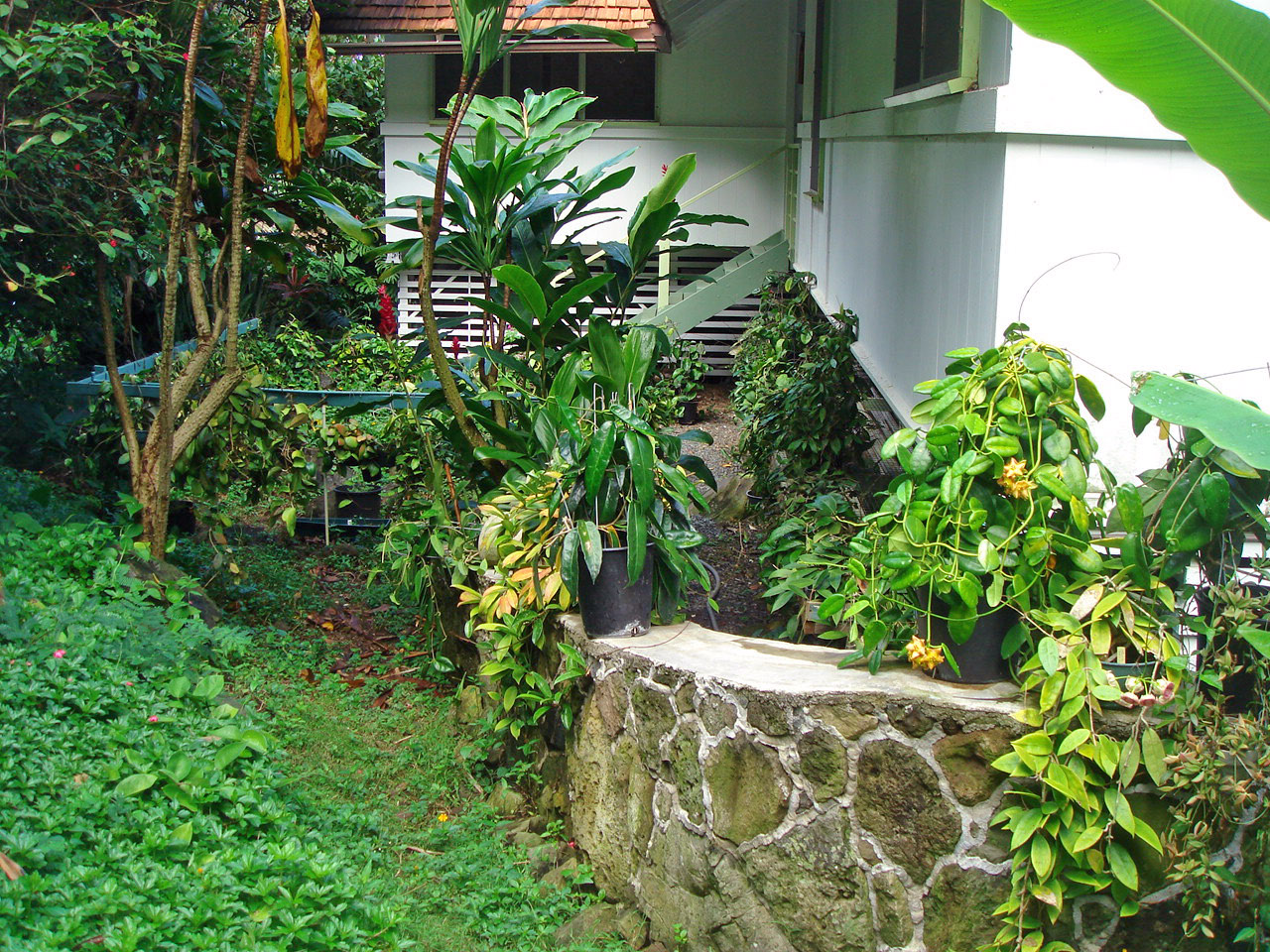
G. Many people ask what our nursery looks like. They think that we have a proper nursery with greenhouses - isn't so! - just our home with a jungle around it - weeds, mosquitoes and tons of hoyas, orchids and other plants. We are about 4 blocks from the beach and at an elevation of about 100 ft. (up against the mountain) in the tiny village of Kaaawa (named after a reef fish), and is pronounced Ka, aa, ava (all as are flat sounding). Here are some pictures from front of the house, left and on around the house. 2 of the cars are ours - the rest are visitors. Bill collectors?
 |
 |
 |
 |
 |
 |
 |
 |
H. I have seen comments and arguments about some of my plants. I have later found out that in some cases the plant in question is not the one that I originally distributed. I have bought or traded to get back a plant that I have lost and then found out what was sent to me was not the correct thing! Where did the correct labeling go astray? Think of the trouble and hard feelings that causes!
I. Or, in an attempt to capitalize on a new plant that I distributed, a new trade name has been dreamed up and the country of origin changed, as the “Funnel Hoya” that is from Sabah, Malaysia, not Papua New Guinea. The correct name of this species is Hoya lambii which I named after my friend Tony Lamb of Kota Kinabalu, Sabah.
J. Hoya collecting should be enjoyable, a pleasure. Just because the several camps disagree over the exact scientific names of several Hoyas doesn’t mean that there should be such mean spirited and vituperative people to ruin the Hoya world! A grower once told me that Hoya collectors are the most disputatious in the plant world! As a famous black philosopher once said: Why can’t we all just get along?
K. PLANT COLLECTING and PERMITS
Dale Kloppenburg and I have been working with Hoyas, for our simple pleasure and the scientific interest, for over 40 years. It has been very interesting and enjoyable – collecting the literature and collecting and comparing the plants, that have come from both the wilds and other’s collections. We have shared the knowledge we have gained by publishing it in books, in horticultural articles and talks to garden clubs and hoya societies around the world. It has always been pleasurable, a two-way street, enjoyed by many.
Now, a serious problem has developed, one caused by the U. S. Department of Agriculture, that is changing all of that. The USDA is now insisting that all plants and plant materials entering the U.S. must be accompanied by a Phytosanitary Certificate from the exporting country. The intent, to quote the USDA, being "to prevent the introduction of plant pests, diseases, and noxious weeds not known to occur here".
If all of the countries, where Hoyas grow wild, were sophisticated (with trained personnel, various offices, and a organized work ethic) that would be wonderful BUT the reality is that they are not. Many of the countries where I have collected are not set up to issue permits, anywhere other than the capital city. The permit might be obtained only to collect a fee and then only after confusion and delays (which are both expensive). This can easily amount to $100 for $10 worth of plants.
It is understandable that an individual country should have the right to establish a conservation program, both for the plant material and intellectual property, but many of the unsophisticated countries have been unduly influenced by the U. S. and U. K. governments. The sharing of conservation tracts has awakened them to, not necessarily to saving species, but a new way to make money – permit selling. Though Hoyas are not covered by CITES, thank God!, if they were that would be another turnstile with a toll. CITES controlled plants (as, Orchids, Nepenthes, etc.) must all be accompanied by a Phyto.
Dale and I found out another tollgate while in Vanuatu in 2001. Upon asking for a Phyto in the second largest town (which is on Espiritu Santo), we were told that we could get it only in the capital, Port Vila on Efate (175 miles away). When we contacted Port Vila, they asked why we hadn’t applied for a "Collecting Permit" before we entered the county? Interestingly, in that permit we would have had to enumerate the species and number we wanted to collect! Who knows what you are going to find – hopefully, a new species or two? This permit system idea is now getting to be quite common and has been "improved upon" to the point where some countries insist that a "team" (with all its expenses) accompany you in your collecting. That team might consist of a representative of the government and a district tribal member.
Typically, branches of government seem to be working a odds with each other: Conservation vs. Forestry vs. Transportation vs. Commerce; as in Sabah where logging is licensed (under Forestry) and yet the plants growing on the trees are protected (under Conservation). Or as, in 2000 a conservation conference was held on Palawan in the Philippines, (with signs everywhere) and yet I saw hundreds of acres of plants being destroyed to widen a new highway north from Puerto Princesa, toward Sabang. The extensive over-clearing for the right-of-way was a disaster!
L. It was pointed out to me, from a comment by a lady in one of the Hoya Chat Rooms, the size of the cuttings that I offer are small. Come to find out, I did not sell the items to her but to another person who proceeded to cut them in half and share, sell or trade to the complainer. I think that this is a reason why some do not ask for replacements - for I ask that the whole dead material be returned, as sent. That is impossible to do if they have been cut up and the half sold or traded off.
M. ORCHIDS IN HAWAII
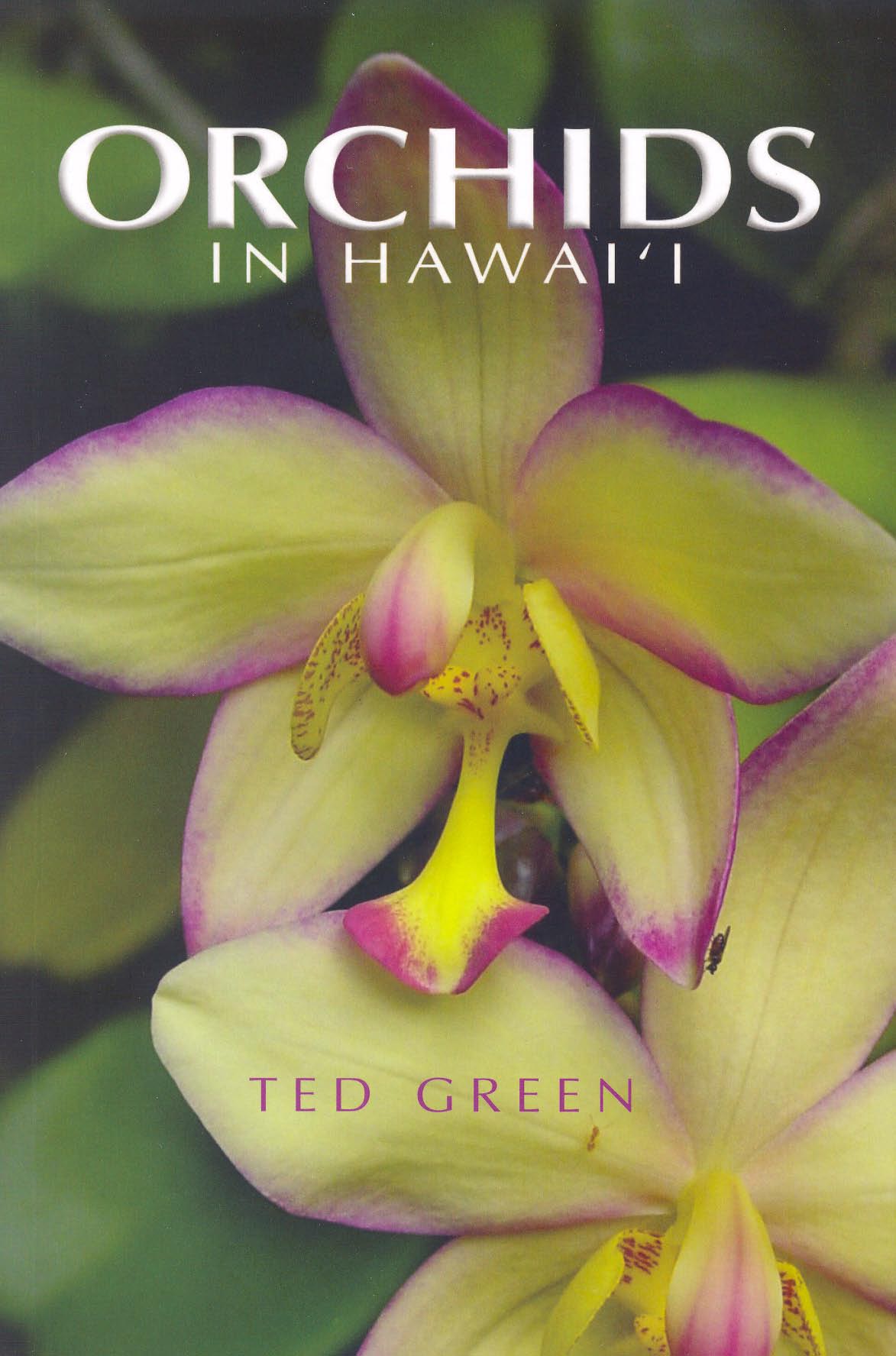
What started out to be my book for tourists in Hawaii has been reconsidered for general distribution and to reach a greater audience. This is a different orchid book. It is NOT a book about growing orchids but where they can be found in Hawaii, recognizing orchids, orchid science, reading labels, nurseries, clubs, meetings, shows, choosing and buying plants, etc. 128 pages, all in color.- even the fly and the ant on the cover!
This book is listed at about $10.95 and is available at garden shops and book stores across the country, AOS Book Store, or from the publisher: www.mutualpublishing.com
Revised